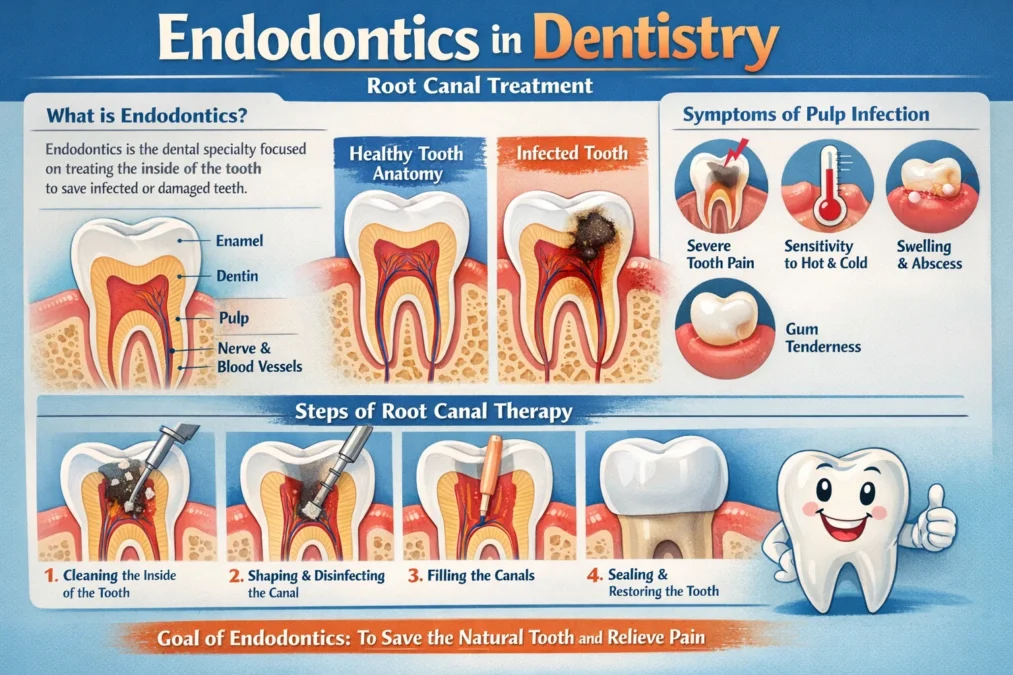
What is Endodontics in Dentistry Let’s face it, a visit to the dentist can make anyone a bit nervous. Words get thrown around, and sometimes they sound more like a scary science class than a path to a healthier smile. If you’ve ever heard the term “root canal,” your mind might have jumped to thoughts of pain and dread. Well, it’s time to flip the script! That procedure is a part of a fascinating and vital dental specialty dedicated to one thing: saving your natural teeth.
So, what is endodontics in dentistry? In a nutshell, it’s the superhero branch of dental care that focuses on diagnosing and treating the soft tissue inside your tooth, rescuing teeth that might otherwise be lost. This article will be your friendly guide, walking you through everything you need to know, from the tiny anatomy of a tooth to the modern miracles endodontists perform every day.
The Very Heart of the Matter: Understanding Tooth Anatomy
To truly grasp what endodontics in dentistry is all about, we need to go on a quick journey inside a tooth. Think of a tooth not just as a hard, white chunk, but as a complex living structure.
- Enamel: This is the super-hard, white outer shell. It’s the strongest substance in your entire body, but it has no feeling.
- Dentin: Just underneath the enamel lies the dentin. It’s a yellowish, bony tissue that makes up the bulk of the tooth. It’s sensitive and has tiny tubes that can transmit sensations.
- Pulp: Ah, here’s the star of the endodontic show! The pulp is the soft, living core of the tooth. Found in the center of the tooth and down through the roots (in “root canals”), it’s a cozy home for blood vessels, nerves, and connective tissue. Its job is to nourish the tooth during its growth and development.
When the pulp gets injured or infected, that’s when an endodontic problem begins, and that’s exactly where the expertise of endodontics comes into play.
The Mission of Endodontics: More Than Just Root Canals
While root canal treatment is their most famous procedure, endodontists are like the detectives and rescue specialists of the dental world. Their mission is multi-layered:
- Diagnosis: Figuring out the exact source of tooth pain can be tricky. Is it the tooth, the gums, the jaw joint, or something else? Endodontists are experts in diagnosing complex tooth pain.
- Treatment: They perform procedures to eliminate infection and inflammation from inside the tooth and its roots.
- Preservation: Their ultimate goal is always to save your natural tooth. Why? Because nothing artificial is as good as the tooth nature gave you.
Meet the Specialist: Who is an Endodontist?
All endodontists are dentists, but not all dentists are endodontists. Think of it like this: a family doctor is fantastic for your overall health, but for a heart issue, you’d see a cardiologist. An endodontist is a cardiologist for your teeth.
After finishing four years of dental school, they complete an additional two or more years of advanced, specialized training in endodontics. They are masters of pain management, use state-of-the-art technology, and become incredibly skilled in performing complex procedures in the tiny spaces inside teeth. This extra training is what gives them the experience, expertise, authority, and trust to handle the most delicate dental situations.
Common Reasons You Might Need Endodontic Care
So, how does the pulp—safe inside the tooth—get into trouble? Several villains can cause an issue:
- Deep Decay: A cavity that’s left unchecked can burrow its way through the enamel and dentin, finally letting bacteria invade the pulp.
- Cracks or Chips: A traumatic injury from a sports accident, a fall, or even chewing something hard can create an opening for bacteria.
- Repeated Dental Procedures: Multiple fillings or work on the same tooth can sometimes stress the pulp.
- Trauma: A hit to the tooth, even without a visible crack, can damage the pulp’s nerve and blood supply.
When the pulp is infected or damaged, it starts to break down. Bacteria multiply in the root canals, and before you know it, you can end up with an abscess—a pus-filled pocket at the end of the root. Ouch! This can lead to serious symptoms.
Warning Signs: Is Your Tooth Asking for Help?
Your body has a way of sending up flares when something’s wrong. Here are the most common signs that the pulp inside your tooth might be in distress:
- Persistent tooth pain, especially when chewing or applying pressure.
- Prolonged sensitivity to hot or cold temperatures, even after the source is removed.
- Discoloration or darkening of the tooth.
- Swelling and tenderness in the nearby gums.
- A pimple-like bump on the gums near the tooth (a dental abscess).
If you notice any of these, don’t bury your head in the sand! Seeing a dentist or endodontist promptly can be the difference between saving and losing the tooth.
The Main Event: Demystifying the Root Canal Procedure
Alright, let’s tackle the big one. The phrase “root canal” actually describes the natural cavity inside the tooth. The procedure is called root canal treatment (or therapy). Thanks to modern dentistry, it’s really no more uncomfortable than getting a standard filling. Here’s a step-by-step breakdown of what actually happens:
- Diagnosis and X-ray: First, the endodontist will examine the tooth, take an X-ray to see the shape of the root canals and check for infection in the bone.
- Anesthesia: The area is completely numbed with local anesthesia. You’ll be awake but shouldn’t feel any pain.
- Access Opening: A tiny protective sheet called a “dental dam” is placed to keep the tooth clean and dry. Then, a small opening is made in the crown of the tooth to reach the pulp chamber.
- Cleaning and Shaping: Using very small instruments, the endodontist carefully removes the diseased pulp, cleans, disinfects, and shapes the inside of the root canals.
- Filling the Space: The cleaned canals are filled and sealed with a biocompatible material, usually a rubber-like substance called gutta-percha.
- Temporary Filling: The access hole is sealed with a temporary filling.
After the procedure, you’ll return to your general dentist, who will place a permanent crown or other restoration on the tooth to protect it and restore its full function. And just like that, your tooth is saved!

Beyond the Basics: Other Specialized Endodontic Procedures
Endodontics isn’t a one-trick pony. These specialists also handle other intricate treatments:
- Endodontic Retreatment: Sometimes, a tooth that has had a root canal can become painful or diseased again months or years later. Retreatment involves reopening the tooth, removing the old filling material, cleaning the canals again, and resealing them.
- Endodontic Surgery (Apicoectomy): When inflammation or infection persists in the bony area at the tip of the root, a small surgery might be needed. The endodontist makes a tiny incision in the gum, removes the infected tip of the root, and seals the end of the root canal.
- Trauma Management: They are experts in treating dental injuries, like teeth that have been knocked out (avulsed) or displaced. Quick action and the right treatment can often save these teeth.
- Internal Bleaching: For a tooth that has darkened after a root canal, an endodontist can perform a procedure to lighten it from the inside out.
The Technology Behind the Trust: Tools of the Trade
Modern endodontics has come a long way, making procedures faster, more comfortable, and more successful. Here’s a peek at some of the high-tech tools:
| Technology | What It Does | The Benefit |
|---|---|---|
| Digital Imaging & 3D Cone Beam CT | Provides detailed, 3D views of the tooth, roots, and jawbone. | Allows for incredibly precise diagnosis and treatment planning, especially for complex root structures. |
| Dental Operating Microscope | Magnifies the inside of the tooth and root canals with bright light. | Lets the endodontist see tiny details, cracks, and additional canals that are invisible to the naked eye. |
| Ultrasonic Instruments | Use gentle sound waves to clean and shape the intricate root canal system. | Provides a more thorough cleaning than hand files alone. |
| Electronic Apex Locators | Small devices that accurately measure the length of the root canal. | Ensures the entire canal is treated without going past the tip of the root. |
Why Saving Your Natural Tooth is Almost Always the Best Choice
When faced with an infected tooth, some people might wonder, “Why not just pull it?” Well, pulling a tooth might seem like a quicker, cheaper solution, but it can lead to other problems down the road. Here’s why endodontic treatment to save your tooth is the gold standard:
- Efficient Chewing: Your natural tooth is designed for chewing. It allows you to eat all your favorite foods without worry.
- Normal Bite Force: Natural teeth can handle more bite force than even the best bridges or dentures.
- Protects Other Teeth: Losing a tooth can cause neighboring teeth to shift, leading to bite problems and making them harder to clean.
- A Natural Look: Nothing looks, feels, or functions quite like your own tooth.
Saving your natural tooth through endodontics helps you maintain your smile, your ability to chew comfortably, and your overall oral health. It’s a long-term investment in yourself!
Dispelling the Myths: Let’s Set the Record Straight
It’s high time we busted some persistent myths about what is endodontics in dentistry and the procedures involved.
- Myth: “Root canal treatment is painful.”
- Truth: With modern anesthesia and techniques, the procedure itself is no more painful than getting a filling. The pain people associate with it is usually the infection before the treatment. The treatment relieves that pain.
- Myth: “It’s better to just pull the tooth.”
- Truth: As we discussed, your natural tooth is always the best option. Extraction should be a last resort.
- Myth: “Root canals cause illness.”
- Truth: This is a long-debunked myth based on century-old, flawed research. There is no valid scientific evidence linking root canal-treated teeth to disease elsewhere in the body.
Your Role in a Successful Outcome
Teamwork makes the dream work! After your endodontic treatment, you play a crucial part:
- Practice Good Oral Hygiene: Brush twice a day, floss daily, and use an antiseptic mouthwash if recommended.
- See Your Dentist Regularly: Don’t skip your check-ups and cleanings.
- Protect Your Tooth: If you play sports, consider a mouthguard. Avoid chewing on extremely hard objects like ice or unpopped popcorn kernels.
- Listen to Your Dentist: Get the permanent crown or restoration placed promptly to protect the now-fragile tooth.
Finding the Right Care for You
If your dentist recommends a root canal or other endodontic treatment, they may refer you to an endodontist. You can also find one through the American Association of Endodontists’ website. Don’t hesitate to ask questions—a good endodontist will welcome them and ensure you feel comfortable and informed every step of the way.
So, the next time someone asks you, “what is endodontics in dentistry?” you can tell them with confidence. It’s the dedicated specialty that combines advanced science, precise skill, and a genuine commitment to preserving your natural smile. It turns stories of tooth loss into stories of tooth rescue, allowing people to keep their teeth for a lifetime. By choosing endodontic care, you’re not just treating a toothache; you’re making a smart, long-lasting investment in your health, your comfort, and your happy, confident smile.
You may also read
David Ortiz Wife: A Complete, Trustworthy, and In-Depth Look at the Woman Behind the Baseball Legend