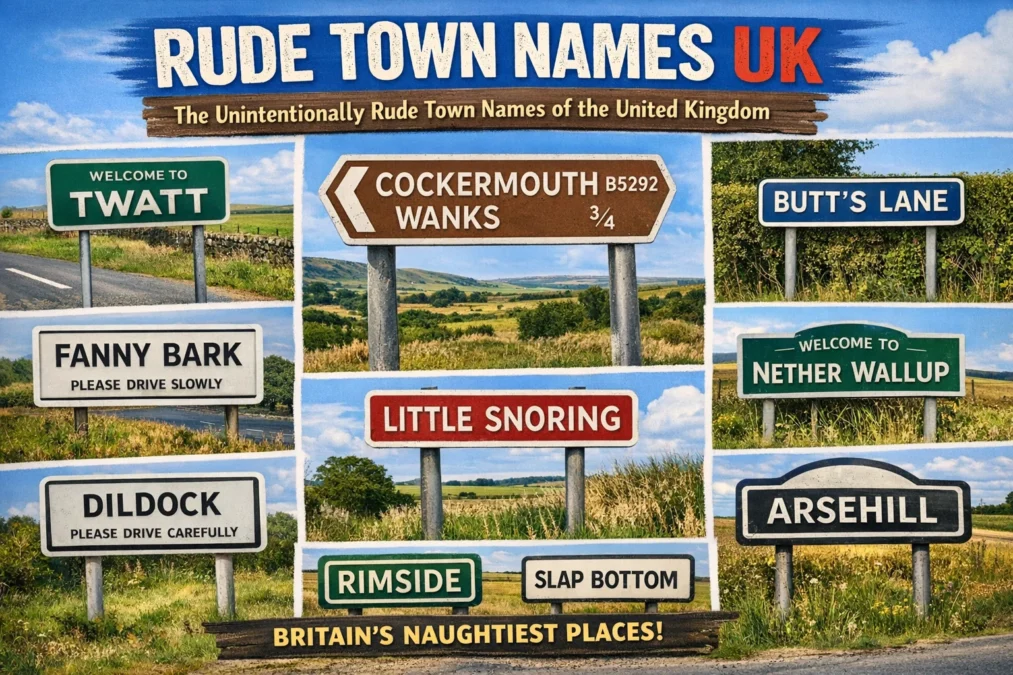
Rude Town Names Uk The United Kingdom’s landscape is a palimpsest of history, each layer etched into the very names of its towns and villages. Among the charming Cotswolds hamlets and picturesque Scottish glens lies a collection of places with names that make the modern ear pause, chuckle, or blush. These unintentionally rude town names UK enthusiasts love to discover are rarely products of ancient vulgarity. Instead, they are fascinating linguistic accidents,
where Old English meets modern slang, innocent Celtic roots collide with contemporary meaning, and phonetic spellings take on a life of their own. This journey into Britain’s nominative curiosities is more than a puerile snigger; it’s a gateway into philology, social history, and the wonderfully unpredictable evolution of language. From Shitterton to Twatt, these places hold stories that are often as rich and compelling as their names are, to our sensibilities, hilariously inappropriate.
The Linguistic Origins of British Place Names
Understanding why Britain has so many seemingly rude town names UK wide requires a dive into the bedrock of its language. Most English place names were coined between the 5th and 12th centuries, a period of immense flux with successive waves of Anglo-Saxon, Viking, and Norman settlement. The words used were practical descriptors of the landscape, its owners, or its use. Old English words like “thwaite” (a clearing), “bottom” or “botham” (a valley), and “clough” (a steep valley) were utterly innocuous topographic terms. Similarly, Old Norse contributed “keld” (a spring) and “erg” (a shieling or hill pasture).
The humour and rudeness are almost entirely anachronistic. Our modern vocabulary and slang have evolved to assign new, often risqué, meanings to these old, utilitarian syllables. A name like “Scratchy Bottom” in Dorset simply meant a valley (“bottom”) with shrubby undergrowth (“scratchy”). “Grope Lane” in several cities referred to a dark, narrow passageway you had to feel your way through. The disconnect between original intent and modern perception is the heart of the phenomenon, turning everyday historical record into a catalogue of accidental jokes that continue to amuse and perplex.
A Categorical Breakdown of Rudeness
The apparent impropriety of these rude town names UK map collectors seek can be loosely sorted into categories based on the type of modern word they evoke. This classification helps us understand the linguistic pathways that led to their current comic status. The first, and largest, category involves innocent Old English or Old Norse words that have become scatological or sexual slang. Think of places like “Shitterton” (from “scitere,” a stream used as a sewer) or “Cockup” (from a hill where woodcocks gathered).
The second category comprises names that are innocent in their component parts but create unfortunate compounds, such as “Nob End” or “Crapstone.” The third involves simple phonetic coincidence, where the pronunciation of a name from one language sounds like a rude word in another, like “Pity Me” in County Durham. Finally, there are the delightfully blunt descriptive names that were never meant to be polite, such as “Ugglebarnby” (a farm belonging to a man named Uglubarth) or “Miserden” (a valley plagued with misery or marsh). Each category reveals a different facet of how language and time conspire to embarrass our ancestors.
The Infamous Case of Shitterton
Perhaps the most headline-grabbing of all Britain’s rude town names UK media loves is Shitterton, a hamlet in Dorset. The name’s origin is, unsurprisingly, functional rather than vulgar. It derives from the Old English “Scitere,” meaning “stream used as a sewer,” and “tun,” meaning farm or settlement. Essentially, it was the farm by the ditch where waste was deposited. For centuries, this was simply a factual, if unglamorous, identifier. The comedic value is entirely a product of modern sensibilities and the evolution of the word “shit” from a standard term for excrement into a potent taboo.
The residents of Shitterton have famously embraced their name’s notoriety while also taking steps to protect it. In a brilliant act of proactive toponymy, the community collectively purchased a two-tonne block of Purbeck stone and had “SHITTERTON” deeply engraved into it, placing it firmly at the entrance to the hamlet. This served two purposes: it became a permanent, theft-proof village sign (previous, smaller signs were constantly stolen), and it reclaimed their unique heritage with pride and a sense of humour. It stands as a monument to the fact that a rude town name UK residents can own is a badge of identity, not shame.
The Curious Geography of Twatt
The name Twatt presents a fascinating double-whammy in the atlas of rude town names UK visitors smirk at. Remarkably, there are two Twatts in Britain: one on the Orkney Mainland in Scotland, and one on Shetland. The name’s origin is Norse, from “þveit,” meaning a small parcel of land, a clearing, or a meadow. It’s a common suffix in Nordic-influenced areas, seen in places like Braithwaite and Langthwaite. The journey from “thveit” to “Twatt” is one of phonetic Anglicisation, where the Old Norse letter “thorn” (þ) was replaced by a “th” sound, which eventually softened.
The two Twatts have differing relationships with their notorious moniker. The Orkney Twatt, near the famous Neolithic site of the Ring of Brodgar, has a sign that is perhaps the most photographed in the islands, often with tourists posing beside it. The Shetland Twatt is more understated, its sign a regular fixture on a lonely road. Both, however, are testaments to the enduring power of Viking settlement on British topography and the endless capacity for language to trip us up centuries later. They are perfect examples of how a rude town name UK linguists study is often a frozen moment of Norse history.
When “Bottom” is Perfectly Respectable
To the modern ear, any place name containing “Bottom” is an automatic source of amusement. Yet, across England, particularly in the north and in Yorkshire, “Bottom” is an exceedingly common and geographically precise suffix. It comes from the Old English “botm” or “bothm,” meaning a valley, specifically a broad, flat one. It speaks to the foundational principle of British place-naming: describe what you see. Hence, we find countless valleys (bottoms) with specific attributes: “Bumblehole Bottom,” “Wormelow Tump,” and the aforementioned “Scratchy Bottom.”
The humour arises from the semantic narrowing of the word “bottom.” In Old and Middle English, it primarily meant the base of something, like a valley or a ship. Over time, its anatomical application became the dominant, and more private, meaning. So, a walk through the tranquil “Micklehurst Bottom” in Greater Manchester was, for our ancestors, a walk through the “big wooded valley.” Today, it simply sounds like a peculiar destination. This shift highlights how the evolution of everyday vocabulary can retrospectively colour our entire landscape with a faintly silly hue, making a simple walk a lesson in linguistic history.
Lost in Translation: Celtic and Norse Echoes
Many of the rude town names UK historians catalogue in Scotland, Wales, and Cornwall stem from a simple case of phonetic misunderstanding. Celtic and Old Norse names were heard by Anglo-Saxon or later English scribes and written down phonetically, often creating spellings that later generations would misinterpret. A classic example is “Pity Me,” a suburb of Durham. Folklore offers various tales of monks or travellers suffering there, but the most likely origin is the Welsh “pittu ma,” meaning “peat land,” or even a corruption of “Petite Mer” (small lake) from Norman French.
Similarly, in Scotland, “Cockenzie” in East Lothian has nothing to do with poultry but is from the Gaelic “Cùil Choinnich,” meaning “Kenneth’s nook.” “Cumbernauld” sounds awkward but comes from Gaelic for “the meeting of the streams.” In these instances, the “rudeness” or oddness is purely in the ear of the English-speaking beholder. The original namers were describing their world with perfect clarity. This category reminds us that a seemingly rude town name UK gazetteers list is often just a fossilised pronunciation of a word from a language that has since retreated from the area.
The Social History Behind the Sniggers
Beyond linguistics, these place names offer a raw, unfiltered window into the lives of our ancestors. They were a pragmatic, no-nonsense people who named things for what they were, without euphemism. A “Grope Lane” (found in Shrewsbury, London, and elsewhere) was a narrow, dark alley where you literally had to grope your way along the walls. “Slag Lane” in Lowton likely referred to an area where waste slag from mining or smelting was dumped. “Cuckold’s Knoll” or “Juggins Hill” might have commemorated a local fool or a well-known personal misfortune.
This bluntness reflects a world where life was hard, privacy was limited, and community memory was the primary record. A name was a functional tool for navigation and reference, not a piece of marketing for future estate agents. The survival of these names, despite later embarrassment, is a testament to the stubborn continuity of local identity. They tell us that our forebears were concerned with utility, not propriety, and in doing so, they inadvertently created a list of rude town names UK social historians find incredibly revealing.
The Battle for Decency: Attempts to Rename
As Victorian sensibilities took hold, the pressure to sanitise the map grew. The proliferation of rude town names UK worthies disapproved of was seen as an embarrassment to a modern, civilised nation. This led to concerted, and often successful, efforts to rename places. Perhaps the most famous example is the Oxfordshire village of “Culham,” which was originally recorded as “Culnehām” – the “ham” (homestead) in the “cul” (bottom or rear). To avoid the obvious association, the “n” was dropped, and the pronunciation shifted.
“Gropecunt Lane,” which existed in several medieval cities as a centre for prostitution, was universally changed to more acceptable variants like “Grape Lane” or “Grope Lane.” In some cases, the change was more subtle: “Shiteburn” became “Shuteburn” and then “Shute.” These acts of toponymic censorship cleaned up the map but also erased a layer of direct, often gritty, social history. They represent a deliberate break between the pragmatic medieval mind and the more prudish modern one, showing that the perception of a rude town name UK officials could alter was powerful enough to rewrite geography.

A Comparative Table of Notorious Names
The table below categorises some of the UK’s most famous inadvertently rude place names, detailing their origins and the type of linguistic accident that makes them amusing today.
| Place Name | County / Region | Likely Origin & Meaning | Category of ‘Rudeness’ |
|---|---|---|---|
| Shitterton | Dorset | OE “Scitere-tūn” – Farm by the sewer stream. | Scatological slang from a literal term. |
| Twatt | Orkney, Shetland | ON “þveit” – A small parcel of land or clearing. | Phonetic coincidence with modern slang. |
| Cockup | Cumbria | Literally “Hill where woodcocks rise up.” | Innocent compound now sexual slang. |
| Muff | County Donegal, IE | Anglicisation of “Magh” (plain). | Phonetic coincidence. |
| Pity Me | County Durham | Possibly Welsh “pittu ma” (peat land). | Phonetic coincidence implying weakness. |
| Gropecunt Lane (Historic) | London, etc. | ME – Literally described the area’s trade. | Literal term now extreme taboo. |
| Nob End | Greater Manchester | “Nob” as a hilltop + “End.” | Innocent compound now sexual slang. |
| Crapstone | Devon | Possibly “Crab” stone or “Cropp” stone. | Phonetic coincidence with scatological slang. |
| Bell End | Worcestershire | “End” of the parish near a bell-like feature. | Innocent compound now sexual slang. |
| Wetwang | East Riding | ON “vett-vangr” – field for trials/meetings. | Phonetic coincidence with sexual slang. |
The Role of Folklore and False Etymology
For every genuinely historical rude town name UK etymologists trace, there is a rich accompanying layer of folk etymology—invented stories that “explain” the name in a more colourful, often mythic, way. The village of “Pity Me” in Durham is surrounded by tales: of monks crying “Pity me!” as they were attacked, or of a pitiful woman abandoned there. While charming, these stories almost certainly post-date the name, created to make sense of an odd-sounding phrase whose original meaning was lost.
Likewise, “Shitterton” might attract tales of terrible sanitation disasters, and “Twatt” might be the subject of bawdy legends about disputes. This human tendency to create narrative is a crucial part of the phenomenon. It shows that people have been puzzled and amused by these names for centuries, long before the internet. The folklore adds a cultural dimension, transforming a linguistic accident into a local legend. As one historian of dialect noted, “Place-name folklore is often more about the character of the people telling the story than the origin of the name itself.” This interplay between hard linguistics and soft story is what gives these locations enduring charm beyond a simple snigger.
Modern Tourism and Embracing the Notoriety
In the age of social media and niche tourism, many communities with rude town names UK travellers seek out have learned to lean into the joke. What was once a source of potential embarrassment is now a unique selling point. The Shitterton stone is a prime example of this—turning a liability into a celebrated, theft-proof landmark. Villages like “Westward Ho!” in Devon (the only UK town with an exclamation mark in its name, from the novel) and “Fucking” in Austria (which famously changed its spelling to Fugging in 2021) show the global scale of this trend.
Local businesses cleverly incorporate the names: imagine the souvenir potential of a postcard from “Twatt” or a tea towel from “Muff.” This commercial embrace does more than just generate income; it fosters a sense of local pride and distinctiveness. It allows residents to control the narrative, acknowledging the humour while educating visitors about the real history. The modern fate of a rude town name UK tourism boards might promote is thus one of reclamation, turning a historical linguistic quirk into a 21st-century community asset.
Legal and Practical Implications
Living with a notorious name isn’t all fun and postcards. There are genuine practical and legal wrinkles. For instance, residents of these places often face issues with online forms that reject their address as containing profanity. Delivery drivers might snigger, but more importantly, automated systems can fail, causing problems with parcel delivery, online registrations, and even credit checks. The fight to have these official names recognised by digital databases is a real, if quirky, modern battle.
From a legal standpoint, the name of a settlement is protected by historical precedent and, usually, local government authority. A council cannot arbitrarily decide to rename “Shitterton” to “Prettyton” without significant local consultation and a compelling reason. The name is part of the area’s statutory records, its history, and its identity. This protection underscores that these are not jokes but legitimate, historical place names with all the legal standing of London or York. The struggle between digital convenience and historical integrity is a new chapter in the story of Britain’s most memorable rude town names.
A Defence of the Undignified
In a world of increasingly homogenised and branded spaces, Britain’s collection of rude town names UK traditionalists cherish represents something vital: an unvarnished, authentic link to the past. They are proof that our landscape was not focus-grouped or sanitised for mass consumption. They are the linguistic equivalent of an uncropped, unfiltered historical photograph, showing the warts-and-all reality of how people lived and spoke. To rename them for comfort would be to engage in a form of historical censorship, airbrushing the earthy practicality of our ancestors from the record.
Furthermore, they are a magnificent tool for engagement. A child (or adult) who giggles at “Cockup” is instantly hooked into asking “why?” That question opens the door to lessons in Old English, Viking settlement, landscape history, and semantic shift. They make philology accessible and history human. In defending these names, we defend the character, individuality, and deep-rooted history of the British landscape against the tide of blandness. Their survival is a small, cheeky rebellion against taking ourselves too seriously.
Conclusion
The tapestry of British place names is rich, complex, and endlessly surprising. The seemingly rude town names UK enthusiasts and linguists are fascinated by are not monuments to ancient vulgarity but rather accidental artefacts of linguistic evolution. They are collisions between the utilitarian language of Anglo-Saxon farmers, Norse settlers, and Celtic tribes and the ever-changing slang of modern English. From Shitterton’s pragmatic waste disposal to Twatt’s Norse clearings, each tells a true story of geography, ownership, and survival.
Their journey from straightforward descriptor to comic relic is a masterclass in how language lives, breathes, and sometimes embarrasses its users centuries down the line. They connect us, through a shared chuckle, to the minds of people long gone who saw a valley and called it a “bottom,” found a clearing and called it a “thveit,” and had a sewer stream and frankly said so. In exploring these names, we do more than just collect amusing anecdotes; we preserve a uniquely unfiltered channel to Britain’s past, proving that history, when you listen closely to the land itself, is never boring and often wonderfully, unintentionally, rude.
Frequently Asked Questions
What is the rudest town name in the UK?
While “rude” is subjective, the most notoriously blunt is likely Shitterton in Dorset, due to its direct scatological modern reading. Historically, medieval “Gropecunt Lane” was certainly the most explicit, but those names were changed centuries ago. The enduring appeal of a rude town name UK discussions centre on often lies in its survival and the community’s reaction to it.
Why does the UK have so many rude-sounding place names?
The UK’s long history of successive linguistic layers (Celtic, Latin, Anglo-Saxon, Old Norse, Norman French) created a rich soup of place-name elements. Over centuries, the meanings of these Old English and Old Norse words faded from common use, while the sounds evolved. Meanwhile, modern English developed new slang meanings for those same sounds, creating accidental rudeness. It’s a perfect storm of linguistic preservation and semantic shift.
Do residents of these places mind their names?
Attitudes vary. Some residents initially find the constant jokes tiresome, especially with modern issues like online address verification. However, many communities have embraced their unique heritage with humour and pride, using the notoriety for local identity and even tourism. Owning a famously rude town name UK media features can foster a strong, defiant sense of local character.
Have any places officially changed their names because of this?
Yes, the Victorian era saw many sanitising changes. “Gropecunt Lane” is the classic example, universally altered. “Culham” and “Shute” are likely milder versions of more explicit originals. Modern changes are rarer and face strong local opposition, as the name is considered part of the area’s history. Changing a rude town name UK councils might consider is now a significant legal and community process.
Are these names actually rude in origin?
Almost never. In 99% of cases, the origin is perfectly innocent, descriptive, or related to a personal name. “Cock” referred to a bird or a hilltop; “bottom” was a valley; “twatt” was a clearing. The rudeness is a modern interpretation, an anachronistic overlay that our ancestors would be utterly baffled by. The history behind a rude town name UK scholars research is typically mundane, not scandalous.
You may also read
Veronika Khomyn: A Modern Archetype of Visionary Leadership and Creative Integrity